
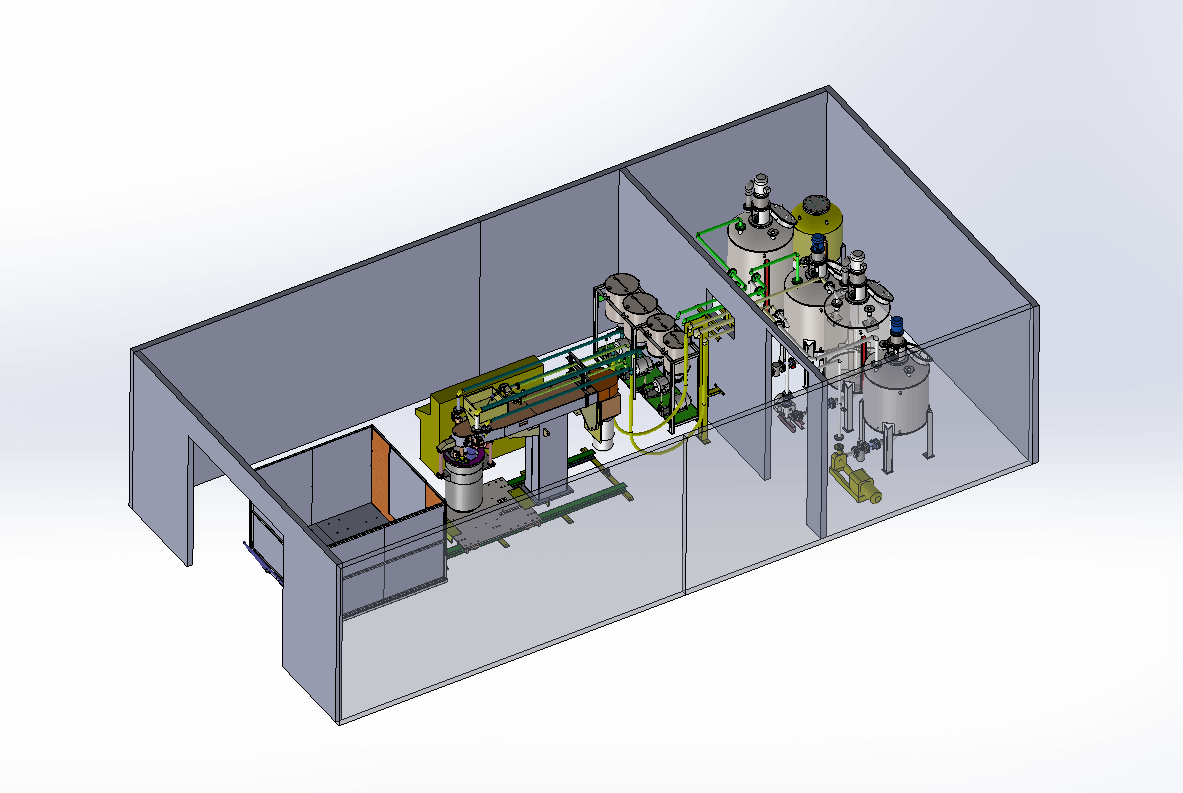
PU Foam Production Process: From Raw Materials to Finished Products
Polyurethane (PU) foam is a versatile material used in furniture, mattresses, insulation, automotive components, footwear and many other applications. Its properties can be adjusted to produce soft, flexible foam or firm, rigid foam. Although formulations vary according to the intended use, most PU foam is made by reacting a polyol blend with an isocyanate.
Key Raw Materials
The main ingredients are polyols and isocyanates. When these components react, they form the polyurethane polymer. Other ingredients help control the foam’s structure and performance:
- Blowing agents: Create the gas that forms the foam’s cells. Water can react with isocyanate to generate carbon dioxide, while other blowing agents may be used depending on the product and process.
- Catalysts: Help control the speed and balance of the chemical reactions.
- Surfactants: Stabilise the foam and help create a consistent cell structure.
- Additives: May provide properties such as colour, flame resistance, improved durability or resistance to ageing.
The selection and proportion of these materials determine characteristics such as density, firmness, resilience, cell structure and thermal insulation performance.
How PU Foam Is Produced
Formulation and preparation
The formulation is selected to meet the requirements of the finished product. Ingredients are measured carefully, and the polyol blend is prepared with the required additives. Consistent raw materials, accurate weighing and controlled storage are important for reliable results.
Metering and mixing
The prepared polyol blend and isocyanate are delivered to a mixing unit in controlled proportions. They are mixed thoroughly to start the chemical reaction. Mixing quality is important: uneven mixing can lead to variations in the foam’s appearance and performance.
Foaming and expansion
After mixing, the reactive mixture is placed into a mould or released onto a moving production line. The reaction generates heat and gas, causing the material to expand. Bubbles form and become the foam’s cellular structure. The formulation and process conditions influence whether the foam has predominantly open or closed cells.
Rise and curing
The foam rises until it reaches the required shape or volume. It then cures as the chemical reactions continue and the polymer structure becomes more stable. Depending on the product and manufacturing method, curing may take place in a mould or in a controlled production area.
Demoulding and conditioning
Moulded parts are removed once they are sufficiently stable. Blocks or slabs may be allowed to rest or condition before further processing. This stage helps the material settle and supports consistent handling and cutting.
Cutting and finishing
Foam blocks can be cut into sheets, rolls or shaped components. Moulded foam may be trimmed and finished to meet design requirements. Finished pieces are then inspected and prepared for packaging or assembly into products.
Common Production Methods
Slabstock production is used to make large blocks of flexible foam, which are later cut into products such as mattress layers and cushioning. Moulded production forms foam directly into a specified shape, making it suitable for items such as automotive seats and contoured components. Rigid PU foam is commonly produced in panels, mouldings or other forms for insulation and construction applications.
Quality Control
Quality checks may cover density, dimensions, firmness, resilience, load-bearing behaviour, cell structure and visual appearance. Depending on the application, manufacturers may also assess thermal insulation, dimensional stability and compliance with relevant safety or product standards. Process controls and regular equipment maintenance help reduce defects and variation between batches.
Safety and Environmental Considerations
PU foam production involves reactive chemicals that require appropriate training and controls. Manufacturing facilities should follow current safety data sheets, use suitable engineering controls and personal protective equipment, and maintain procedures for handling, storage, spills and waste. Ventilation and exposure controls are particularly important during chemical handling and foaming operations.
Manufacturers can also reduce environmental impact by improving material efficiency, controlling process waste, selecting suitable lower-impact blowing-agent options and exploring reuse or recycling routes for production scrap and end-of-life foam. The right approach depends on the foam type, application and available local facilities.
Conclusion
PU foam production combines carefully selected raw materials with controlled mixing, expansion, curing and finishing. By managing each stage and verifying the finished product, manufacturers can produce foams tailored to a wide range of comfort, support, insulation and performance needs.
6 Key Benefits of the PU Foam Production Process
- Versatile formulations suit many applications.
- Production can be tailored to different firmness levels.
- Lightweight foam offers efficient material use.
- Moulding enables complex shapes and designs.
- Consistent process control supports product quality.
- Foam provides useful cushioning and insulation.
Key Challenges in PU Foam Production: Chemical Safety, Emissions, Recycling and Quality Control
- Uses reactive chemicals that require careful handling.
- Production can release emissions if controls are inadequate.
- Offcuts and end-of-life foam can be difficult to recycle.
- Product quality depends on precise mixing and process control.
Versatile formulations suit many applications.
A key advantage of the PU foam production process is its versatility. By adjusting the formulation and processing conditions, manufacturers can create foams with different levels of firmness, density, flexibility and insulation performance. This makes PU foam suitable for a wide range of applications, from mattresses, furniture and automotive seating to building insulation, footwear and protective packaging.
Production can be tailored to different firmness levels.
PU foam production can be tailored to achieve different firmness levels, from soft, comfortable cushioning to firm, supportive foam. Manufacturers adjust the formulation and processing conditions to suit the intended application, whether it is mattresses, furniture, automotive seating or insulation. This flexibility allows the finished foam to deliver the required level of comfort, support and performance.
Lightweight foam offers efficient material use.
One key advantage of the PU foam production process is the ability to create lightweight products that use materials efficiently. The foam’s cellular structure provides useful cushioning, support or insulation with relatively little material, helping reduce product weight and making handling and transportation easier. When the formulation and process are carefully controlled, manufacturers can achieve the required performance while limiting material use and production waste.
Moulding enables complex shapes and designs.
Moulding is a key advantage in the PU foam production process, as it allows manufacturers to create complex shapes and detailed designs directly in the mould. This makes it possible to produce components with curves, contours and integrated features that may be difficult or costly to achieve through cutting alone. The result is greater design flexibility, efficient production and foam parts tailored to the requirements of applications such as automotive seating, furniture and protective packaging.
Consistent process control supports product quality.
Consistent process control is essential for producing PU foam with reliable quality. Carefully monitoring ingredient quantities, mixing, temperature, foaming and curing helps maintain uniform density, cell structure and performance across batches. This reduces defects and material wastage, while helping ensure that finished foam meets the requirements of its intended application.
Foam provides useful cushioning and insulation.
One of the key benefits of the PU foam production process is its ability to create materials that provide effective cushioning and insulation. By adjusting the formulation and foam structure, manufacturers can produce soft, resilient foam that absorbs impact and supports comfort in products such as mattresses, furniture and vehicle seats. PU foam can also help reduce heat transfer, making it useful for insulation in buildings, appliances and refrigerated applications.
Uses reactive chemicals that require careful handling.
PU foam production uses reactive chemicals, including isocyanates, which require careful handling throughout storage, mixing and manufacturing. Without appropriate training, ventilation, protective equipment and safe work procedures, workers may be exposed to hazardous substances. These precautions are essential, but they can increase production costs and require ongoing monitoring and staff training.
Production can release emissions if controls are inadequate.
PU foam production can release emissions during the handling and reaction of its raw materials, particularly when ventilation and process controls are inadequate. These emissions may affect workplace air quality and the surrounding environment. Effective engineering controls, well-maintained equipment, safe handling procedures and appropriate monitoring help minimise emissions and protect workers and nearby communities.
Offcuts and end-of-life foam can be difficult to recycle.
A key drawback of PU foam production is that offcuts and end-of-life products can be difficult to recycle. Foam may contain different chemicals, additives, fabrics or other materials that are hard to separate, while its bulky, lightweight form can make collection and transport less economical. As a result, some foam waste may be sent to landfill or energy recovery instead of being recycled into new products. Better waste sorting, improved recycling technologies and product designs that make materials easier to separate can help reduce this challenge.
Product quality depends on precise mixing and process control.
Product quality in PU foam production depends on precise mixing and consistent process control. Even small variations in the proportions of raw materials, mixing time, temperature or curing conditions can affect the foam’s density, firmness, cell structure and durability. Manufacturers therefore need accurate dosing equipment, well-maintained machinery and regular quality checks to ensure consistent results and minimise defects.