
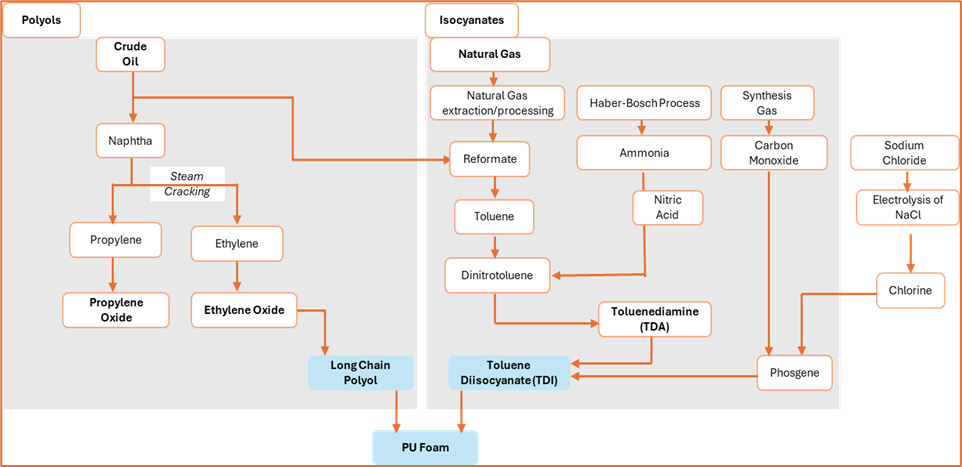
Polyurethane Production Process: From Raw Materials to Finished Products
Polyurethane is a versatile family of polymers used in products such as furniture foam, insulation panels, footwear, mattresses, coatings, adhesives, sealants and automotive components. Its properties can be adjusted to produce materials that are soft or rigid, flexible or durable, and lightweight or dense.
Unlike many plastics, polyurethane is generally made by reacting two main liquid components at the point of manufacture: a polyol and an isocyanate. The exact formulation and processing method depend on the product being made.
Key Raw Materials
- Polyols: Compounds with multiple hydroxyl groups. They form the flexible or structural part of the polymer and influence properties such as softness, strength and resilience.
- Isocyanates: Reactive compounds that combine with polyols to form polyurethane. Common industrial types include TDI and MDI.
- Additives: Ingredients such as catalysts, surfactants, blowing agents, colourants, flame retardants and fillers may be used to achieve specific processing or performance requirements.
Each formulation is designed for its intended application. For example, flexible foam requires a different balance of ingredients from rigid insulation foam or a tough elastomer.
How Polyurethane Is Made
Formulation and preparation
The manufacturer selects the polyol, isocyanate and any required additives according to the desired product properties. Components are measured carefully, and may be conditioned or mixed separately before processing. Accurate proportions are important for consistent quality.
Metering and mixing
The liquid components are delivered in controlled quantities to a mixing head or other processing equipment. They are blended rapidly to create a uniform reaction mixture. The mixing method and processing conditions are selected for the product and production scale.
Chemical reaction and expansion
Polyol and isocyanate react to form polyurethane. In foam production, a blowing agent or a gas-generating reaction creates cells within the material. The mixture expands and begins to set. In solid polyurethane products, the formulation is processed without creating a foam structure.
Moulding, pouring or coating
The reacting mixture is placed into a mould, poured onto a production line, applied to a surface or otherwise shaped. Flexible foam may be produced as large blocks and later cut to size. Rigid foam is often formed in panels or within an insulated structure. Other formulations can be moulded into components or applied as coatings, adhesives and sealants.
Curing and finishing
The material is allowed to cure so that the chemical reaction can progress and the product can develop its intended properties. Depending on the process, it may then be demoulded, cut, trimmed, laminated, coated or assembled with other materials. Quality checks are carried out before the product is packed or sent for further processing.
Different Production Routes
The broad chemical principle is similar across polyurethane products, but the production route varies:
- Flexible polyurethane foam: Used in mattresses, seating and cushioning. The formulation creates a soft, cellular material with the required comfort and support.
- Rigid polyurethane foam: Used in building insulation, appliances and cold-chain applications. Its cellular structure helps provide thermal insulation and structural support.
- Elastomers and moulded parts: Formulated for wear resistance, resilience and durability in products such as wheels, rollers, seals and technical components.
- Coatings, adhesives and sealants: Applied as liquids or pastes and cured to form protective, bonding or sealing layers.
- Thermoplastic polyurethane (TPU): Produced as a thermoplastic material that can be softened by heat and processed using methods such as extrusion or injection moulding.
Quality and Process Control
Consistent polyurethane production depends on controlling several factors, including raw-material quality, component proportions, temperature, mixing, moisture levels, reaction time and curing conditions. Manufacturers may test products for properties such as density, hardness, flexibility, tensile strength, adhesion and thermal performance. The relevant tests depend on the product and its intended use.
Safety and Environmental Considerations
Polyurethane production requires trained personnel, suitable equipment and robust workplace controls. Isocyanates can pose serious health risks, particularly through inhalation or skin contact, so industrial handling must follow applicable safety requirements. Facilities use measures such as appropriate ventilation, exposure controls, personal protective equipment, safe storage and emergency procedures.
Environmental management is also important. Manufacturers work to minimise material waste, manage emissions and dispose of chemicals responsibly. Product design, efficient production and recycling or recovery options can help reduce the environmental impact of polyurethane products over their life cycle.
Conclusion
The polyurethane production process combines carefully selected raw materials with controlled mixing, shaping and curing. By changing the formulation and manufacturing method, producers can create materials ranging from soft cushioning foam to rigid insulation and durable engineering components. This adaptability has made polyurethane an important material across construction, transport, furniture, footwear and many other industries.
9 Advantages of the Polyurethane Production Process
- Versatile formulations suit a wide range of products.
- Production can be tailored to specific performance needs.
- Rapid reactions support efficient manufacturing.
- Moulding enables complex shapes and designs.
- Foaming creates lightweight materials.
- Process controls help ensure consistent product quality.
- Different methods support both small and large production runs.
- Polyurethane can be made into foams, coatings, adhesives and elastomers.
- Efficient material use can help reduce production waste.
Safety, Environmental and Recycling Challenges in Polyurethane Production
- Isocyanates require strict safety controls during handling.
- Production can generate chemical waste and emissions.
- Products may be difficult to recycle or dispose of.
Versatile formulations suit a wide range of products.
Polyurethane production allows manufacturers to adjust formulations to meet the needs of many different products. By varying the polyols, isocyanates and additives, they can create materials with specific levels of softness, strength, flexibility, density and durability. This versatility makes polyurethane suitable for applications ranging from soft cushioning in mattresses and furniture to rigid insulation panels, footwear, coatings, adhesives and industrial components.
Production can be tailored to specific performance needs.
A key advantage of the polyurethane production process is that it can be tailored to meet specific performance needs. By adjusting the types and proportions of polyols, isocyanates and additives, manufacturers can create products with desired properties such as flexibility, firmness, strength, durability, insulation and resistance to wear. This versatility allows polyurethane to be designed for a wide range of applications, from soft cushioning and footwear to rigid insulation panels and durable industrial components.
Rapid reactions support efficient manufacturing.
Polyurethane production involves rapid chemical reactions between the polyol and isocyanate components, allowing materials to form and cure quickly. This can shorten production cycles, increase manufacturing efficiency and help manufacturers produce a high volume of products with consistent quality. With carefully controlled mixing and processing conditions, rapid reactions also support streamlined production across applications such as foam, moulded components, coatings and adhesives.
Moulding enables complex shapes and designs.
Moulding is a key advantage of the polyurethane production process, as it allows manufacturers to create complex shapes and detailed designs with precision. The material can be formed directly into components with varied contours, textures and thicknesses, often reducing the need for extensive machining or extra assembly. This flexibility supports product innovation and makes polyurethane suitable for applications ranging from customised furniture and footwear to automotive parts and industrial components.
Foaming creates lightweight materials.
Foaming is a key advantage of the polyurethane production process because it creates materials that are lightweight yet practical for a wide range of uses. As the mixture expands, tiny cells form within the material, reducing its overall density without necessarily compromising the performance required for the application. This makes polyurethane foam suitable for products such as furniture, mattresses, vehicle interiors and insulation panels, where low weight can support easier handling, improved comfort and greater energy efficiency.
Process controls help ensure consistent product quality.
Process controls play an important role in polyurethane production by helping maintain consistent product quality from batch to batch. Careful monitoring of ingredient proportions, temperature, mixing, reaction time and curing conditions helps ensure that the finished material meets its required specifications. This consistency supports reliable performance in applications ranging from foam cushioning and insulation to coatings and components.
Different methods support both small and large production runs.
Polyurethane can be produced using methods suited to both small and large production runs. Small batches can be made through flexible processes such as hand mixing and moulding, which are useful for prototypes or customised products. For higher volumes, automated metering, mixing and moulding systems enable faster, consistent production. This flexibility helps manufacturers choose a process that matches their output needs, product design and available resources.
Polyurethane can be made into foams, coatings, adhesives and elastomers.
One of the key advantages of the polyurethane production process is its versatility. By adjusting the formulation and processing method, polyurethane can be made into a wide range of products, including soft or rigid foams, protective coatings, strong adhesives and durable elastomers. This flexibility allows manufacturers to tailor polyurethane for applications across industries such as construction, furniture, automotive, footwear and appliances.
Efficient material use can help reduce production waste.
Efficient material use in the polyurethane production process can help reduce waste and make better use of valuable raw materials. Accurate dosing, controlled mixing and well-planned moulding or cutting can minimise offcuts, rejects and excess material. By improving process efficiency, manufacturers can lower disposal needs and support more responsible resource use while maintaining product quality.
Isocyanates require strict safety controls during handling.
One important challenge in polyurethane production is the safe handling of isocyanates, which are reactive chemicals used in the manufacturing process. Exposure can irritate or sensitise the skin and respiratory system, so workplaces need strict controls, including suitable ventilation, protective equipment, safe storage and careful handling procedures. Staff must also receive appropriate training, and spills or accidental exposure should be managed promptly in line with safety requirements.
Production can generate chemical waste and emissions.
Polyurethane production can generate chemical waste and emissions during the handling, mixing and curing of raw materials. If these are not properly controlled, they may affect air quality, create risks for workers and contribute to environmental pollution. Manufacturers can reduce these impacts through effective ventilation and emission controls, safe chemical handling, waste minimisation and responsible treatment and disposal of production residues.
Products may be difficult to recycle or dispose of.
A key drawback of polyurethane production is that many finished products can be difficult to recycle or dispose of responsibly. The material is often combined with fabrics, metals or other substances, while thermoset polyurethane cannot simply be melted and reshaped like conventional thermoplastics. As a result, some products may end up in landfill or require specialised recycling and recovery facilities. Improving product design, collection systems and recycling technologies can help reduce this challenge.