
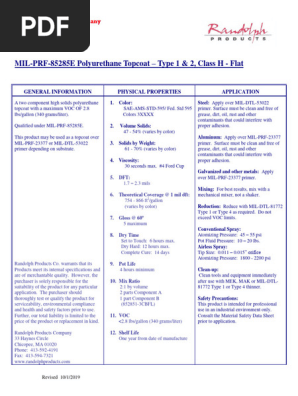
MIL-PRF-85285F: An Overview of the Aircraft Polyurethane Coating Specification
MIL-PRF-85285F is a United States military performance specification for polyurethane coatings used on aircraft and support equipment. It sets requirements for coating performance and testing, rather than prescribing one exact paint formula. The specification is used in military aviation and may also be referenced by commercial and industrial users seeking durable exterior coatings.
What the specification covers
The “F” in MIL-PRF-85285F identifies a revision of the specification. It is important to check the applicable revision and any amendments when preparing a purchase order or assessing a coating. A product described simply as “MIL-PRF-85285” may not provide enough information to confirm that it meets the required version, category or colour.
Products covered by the specification are evaluated against requirements relevant to their intended use. Depending on the applicable category, these can include properties such as adhesion, flexibility, resistance to impact and exposure to fluids, and retention of appearance or performance after environmental testing. The precise requirements and test methods are defined in the official specification.
Types, classes and product selection
The specification uses types and classes to distinguish coating options and their required characteristics. These designations can relate to matters such as formulation or finish. They should not be treated as interchangeable: the correct combination depends on the equipment, operating environment, appearance requirements and applicable procurement documents.
When selecting a product, confirm the exact type and class required, along with the colour, gloss level and any other contract-specific requirements. Check the manufacturer’s technical data sheet and verify the product’s qualification or listing status against the relevant official records. Qualification of a product does not automatically mean that every application method, surface preparation or coating system will be suitable for a particular aircraft.
Why these coatings are used
Polyurethane topcoats are valued in aviation for their potential to provide a durable finish with good resistance to weathering, abrasion and commonly encountered fluids. A properly selected and applied coating can help protect the underlying surface while maintaining the required appearance. Actual performance depends on the product, substrate, preparation, application conditions, film thickness and curing process.
Application and safety considerations
MIL-PRF-85285F specifies performance requirements; it is not, by itself, a complete application procedure. Follow the coating manufacturer’s instructions and the aircraft or equipment maintenance documentation for surface preparation, compatible primers, mixing, application and curing. Do not assume that different manufacturers’ products can be combined in one system without confirmation of compatibility.
Polyurethane coatings and their hardeners may present serious health hazards, including risks associated with isocyanates. Application should be carried out by trained personnel using the protective equipment, ventilation and controls required by the product safety data sheet and applicable workplace regulations.
What to include in a purchase specification
- The full specification number and required revision, including applicable amendments.
- The required type and class.
- The colour and finish requirements.
- Any qualification, documentation or testing requirements.
- Requirements for compatibility with the primer and the rest of the coating system.
Conclusion
MIL-PRF-85285F provides a performance framework for polyurethane coatings used on aircraft and support equipment. Choosing a suitable coating requires more than checking the specification number: users should confirm the exact category, verify the product’s current qualification status and follow the approved application and safety instructions. For procurement or maintenance work, the controlling contract documents and official specification should always take precedence over a general product description.
8 Essential Tips for Applying MIL-PRF-85285F Coatings
- Check the contract for the required MIL-PRF-85285F type and colour.
- Use a coating approved for the specified application.
- Prepare and clean the substrate as the specification requires.
- Follow the product data sheet for mixing and induction time.
- Apply only within the stated temperature and humidity limits.
- Use suitable ventilation and protective equipment when handling the coating.
- Verify film thickness and curing against the approved instructions.
- Record batch details, application conditions and inspection results.
Check the contract for the required MIL-PRF-85285F type and colour.
Before ordering or applying a coating, check the contract and related procurement documents for the exact MIL-PRF-85285F type and colour required. These details can affect product selection, appearance and compliance, so do not rely on a general specification reference or assume that another type or colour is acceptable. Verify that the product documentation matches the contract requirements before work begins.
Use a coating approved for the specified application.
Use a coating approved for the specified application, and verify that it meets the required MIL-PRF-85285F revision, type and class. Approval for one aircraft, component or operating environment does not automatically make a coating suitable for another. Check the contract documents, product qualification records and manufacturer’s instructions before purchase and application.
Prepare and clean the substrate as the specification requires.
Before applying a MIL-PRF-85285F coating, prepare and clean the substrate in accordance with the applicable specification, approved maintenance procedures and coating manufacturer’s instructions. Remove contaminants, corrosion, loose material and residues, and ensure the surface is properly prepared and dry before coating. Correct preparation helps the coating adhere and perform as intended; follow the specified methods and safety precautions, and do not substitute unapproved cleaning products or processes.
Follow the product data sheet for mixing and induction time.
Always follow the product data sheet when mixing a MIL-PRF-85285F coating, including the specified component ratio and mixing procedure. Observe the stated induction time—the period the mixed coating must stand before application—as well as the product’s pot life and application window. These requirements can vary between products, and incorrect mixing or timing may affect curing, adhesion and coating performance.
Apply only within the stated temperature and humidity limits.
Apply MIL-PRF-85285F coatings only when the temperature and humidity are within the limits stated in the product’s technical data sheet and applicable application instructions. Conditions outside these limits can affect application, drying, curing and the quality of the finished coating. Check the ambient and surface temperatures, as well as humidity, before and during application, and postpone the work if conditions are unsuitable.
Use suitable ventilation and protective equipment when handling the coating.
When handling MIL-PRF-85285F polyurethane coatings, use suitable ventilation and the protective equipment specified in the product’s safety data sheet. These coatings and their hardeners may contain hazardous chemicals, so follow workplace safety procedures, use appropriate respiratory and skin protection, and ensure the work area is adequately ventilated. Only trained personnel should mix or apply the coating, in accordance with the manufacturer’s instructions and applicable regulations.
Verify film thickness and curing against the approved instructions.
For coatings meeting MIL-PRF-85285F, verify that the applied film thickness and curing conditions follow the approved product instructions and applicable maintenance documents. Correct thickness and cure time can affect adhesion, finish quality and long-term performance. Use the specified measurement method, record relevant application conditions, and do not rely on touch-dry appearance alone to confirm that the coating has fully cured.
Record batch details, application conditions and inspection results.
For MIL-PRF-85285F coating work, keep clear records of the product and batch details, including the batch or lot number and expiry date. Note the application conditions, such as temperature, humidity, surface preparation and curing time, along with the application method and any relevant measurements. Record inspection results and corrective actions as well. This documentation supports traceability, helps identify the cause of defects and provides evidence that the coating process followed the applicable specification and project requirements.